Feedback calibration training improves whisky sensory profiling
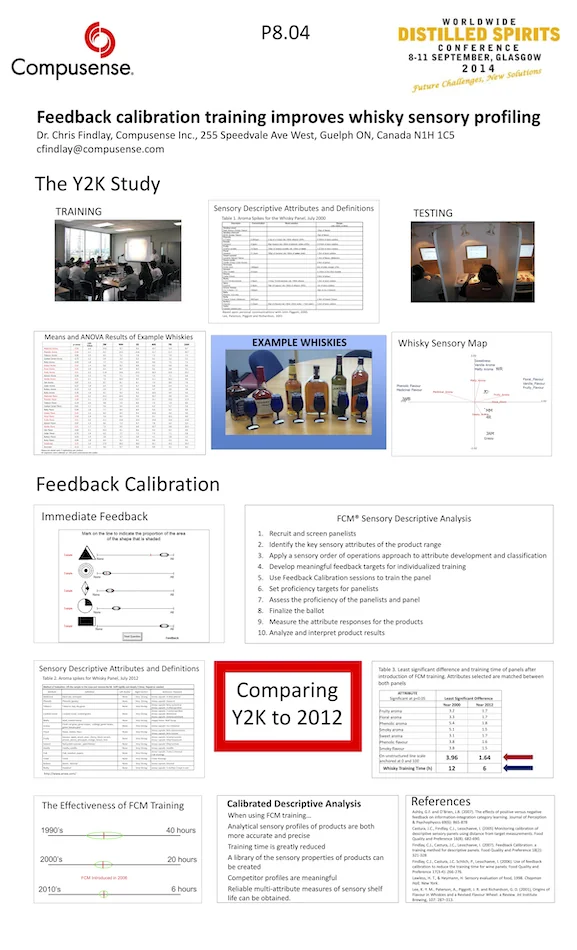
Sensory descriptive analysis of whisky is a valuable tool for understanding the sensory properties of products, the impact of process, aging and blending. When descriptive analysis (DA) is calibrated it can be used to compare products over time and origin. Traditionally, calibration was achieved by lengthy training of panellists and the precision of their results was limited. This made DA both time-consuming and expensive. By using a combination of well-defined attribute standards obtained from AROXA™ and applying the immediate feedback calibration method (FCM) it was possible to cut the panel training time in half, whilst providing accurate and more precise sensory descriptive profiles.
Whisky sensory work conducted in the year 2000 is contrasted with similar work done in 2012 using the FCM training method.
The traditional approach required 6 days of training to prepare the 10 member panel to use 30 attributes to profile 10 whisky samples in 3 replications. Thirteen attributes were found to be significantly different at p<0.05 and the mean Least Significant Difference (LSD) for those attributes was 3.9 on a 100 point intensity line-scale. In 2012, a 12 member panel used the same attributes to profile 10 different whisky products in triplicate, after 3 – 2 hour training sessions using FCM. Of the 13 attributes that were determined to be significantly different the mean LSD was 1.6.
Findlay, C.J. (2014). Feedback calibration training improves whisky sensory profiling. In: Worldwide Distilled Spirits Conference. 8-11 September. Glasgow, Scotland.